|
|
|
|
 |
 |
INTRODUCTIONS |
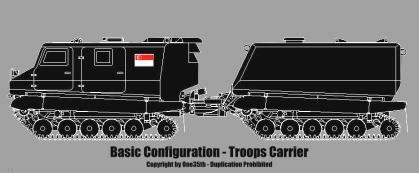
All Terrain Tracked Carrier (ATTC) - Basic Configuration |
|
|
|
| Making
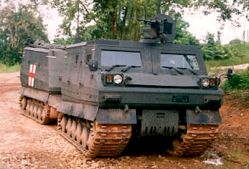
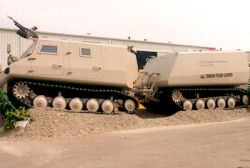
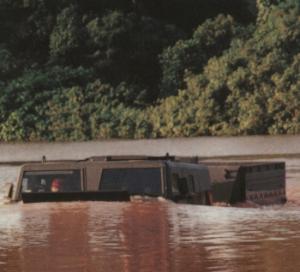
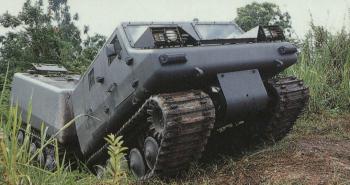
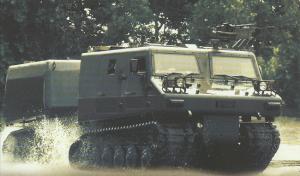
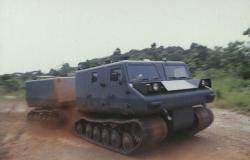
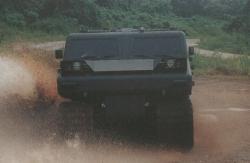
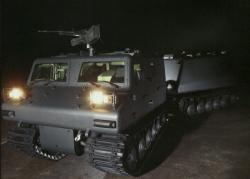
advances on all fronts By Chan Kay Min - The Straits Times - May 3, 2001 This is one Hercules of a military vehicle and yet, it is incredibly light-footed. Although it can haul five tones of cargo over muddy ground, climb up steep slopes and even swim in water with ease, it has a ground pressure as light as a human foot, said a Defense Ministry statement. This the All Terrain Tracked Carrier or ATTC, made in Singapore Technologies Kinetics. ST Kinetics unveiled it before Deputy Prime Minister and Minister for Defense and other guests at its Portsdown Road Facility. The ATTC looks like two boxes on tracks joined by a steering unit. However, its ungainly appearance belies its capability in going places where other vehicles cannot. At the roll-out ceremony, the army looked for a vehicle to meet the operational needs of our mechanized forces, there were no ready solutions in the market, ST Kinetics proposal was chosen as it met the army requirements. During the vehicle's six year development, the company sought input from the armed forces, research institutions and mindef's DSTA on the design.
|
|
|
DSTA helps develop the All Terrain Tracked Carrier (ATTC) DSTA - May 2, 2001 The Defence Science & Technology Agency (DSTA) worked hand in hand with the Army and ST Kinetics to build an All Terrain Tracked Carrier (ATTC) to augment the Army’s mechanized force. DSTA engineers gave valuable inputs in the following areas of expertise: 1. Programme management The project management team from DSTA managed the development of the ATTC and ensured that it is delivered to the Army on time and on budget. Activities carried out by the team included specifying technical requirements, reviewing designs and conducting evaluation trials. The DSTA project team was able to achieve synergies in the development of the ATTC, as members contributed significantly in their areas of specialization. 2. Ergonomics DSTA harnessed human
factors engineering (HFE) to enhance the human effectiveness, comfort and safety of the
ATTC. A well-designed man-machine interface considers factors such as leg clearance, body angles and
functional arm reach to ensure crew comfort, reduce crew fatigue and get the best possible
human performance when using the ATTC. To ensure that SAF
servicemen can carry out their duties effectively, studies were carried out to
optimize the man-machine interface. 3. Communications systems integration DSTA equipped the ATTC with a digital intercom system, the first for an Army vehicle platform. This system is cost-effective and compatible with existing SAF communications equipment. DSTA carried out technical evaluations to ensure that the ATTC communications systems can integrate seamlessly with other sub-systems on the ATTC. DSTA engineers performed electromagnetic analysis to position radio antennas on the ATTC for optimal performance. 4. Weapon integration DSTA helped select and integrate weapon systems that meet safety and effectiveness requirements. Firing acceptance tests were planned and conducted. DSTA analyzed the results from these tests and recommended ways to enhance performance and safety of the weapon systems on the ATTC. 5. Reliability & Maintainability (R&M) assurance DSTA saves operational and support costs by ensuring that the ATTC can withstand harsh military operating environments and has a high operational availability. Detailed tests were carried out before the finalization of the design to ensure a reliable and maintainable ATTC. Failure analysis was one of the tasks conducted to identify R&M design improvement during developmental trials. |
|
"New All Terrain Vehicle Makes Tracks For
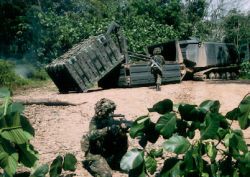
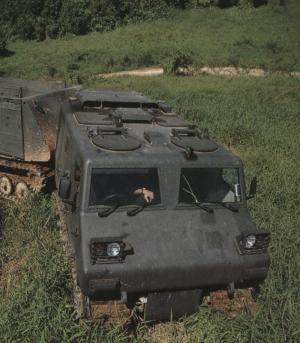
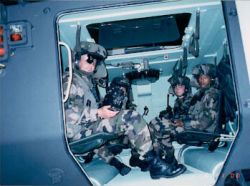
Eurosatory" As part of a determined drive to market its expanding range of tracked Armored vehicles, Singapore Technologies Kinetics has brought its new articulated All Terrain Tracked Carrier (ATTC) to Eurosatory. Singapore Technologies Kinetics only revealed the ATTC in March this year, so far two preproduction vehicles have been built - one in a cargo carrier version and the other, shown at Eurosatory, in the troop carrier configuration. The ATTC comprises two fully Armoured units, front and rear, connected by a hydraulic articulated joint that features steering and damping cylinders. The hull is of all welded steel armour which provides the occupants with protection from 7.62mm small arms fire and shell splinters. A German IBD passive armour package can be fitted to provide a higher level of armor protection if required. When being used as a troop carrier, the ATTC can carry a total of 16 - six in the front, including the driver and vehicle commander, and 10 in the rear unit, plus their equipment. Maximum quoted payload for the front unit is 1,200kg and for the rear unit 3,000kg. It is fully amphibious, being propelled in the water by its rubber tracks at a maximum speed of 5km/h. For local protection the ATTC can be fitted with a roof-mounted 7.62 or 5.56mm machine gun and banks of electrically operated smoke grenade launchers. Optional equipment includes a passive night vision system and a land navigation system. The endless molded rubber bank tracks were developed specially for the ATTC by Soucy of Canada and are lighter and quieter than conventional steel tracks. Mounted under the rear part of the front compartment is the power pack, which comprises a Caterpillar 3126B four-stroke turbocharged air-cooled diesel developing 350bhp, coupled to an Allison MD 3560P fully automatic transmission. Today, the Singapore Armed Forces use the Swedish Hagglunds Vehicle unarmored Bv 206 for a wide range of battlefield support roles. It is possible that in the future the new ATTC will gradually undertake some of these roles as it is not only Armored, but has a significant increase in load-carrying capability, which enables it to undertake a much wider range of battlefield roles than the older Bv 206. In addition to being used as a cargo carrier, other roles
suggested for the ATTC by Singapore Technologies Kinetics include use
as an ambulance, weapons carrier, reconnaissance platform command and
control vehicle, internal security and a number of specialized civilian
roles. |
|
ST Kinetics Wins Finnish Study Contract (Source:Singapore Technologies; issued Oct. 25, 2004) WASHINGTON --- Singapore Technologies Kinetics (ST Kinetics) has been awarded a study contract in July 2004 by the Finnish Defence Forces Materiel Command (DFMC) to explore the development of a Future All Terrain Vehicle (FATV) for the Finnish Defence Force (FDF). In the contract, ST Kinetics will evaluate new technologies for the FATV, which is intended to replace the FDF’s current fleet of articulated vehicles by 2010-2012. The study is expected to conclude by March 2005. The study contract is an endorsement of ST Kinetics’ extensive experience and technical competency in the development of both tracked and wheeled solutions. Its experience with the Bronco All Terrain Tracked Carrier in particular, has been extremely successful. In fact, the Bronco has successfully completed exhaustive FDF trials for 6 months in 2003, covering over 8,000 km of harsh Finnish arctic terrain and weather. Today, the Bronco has been extensively tested through rigorous sand and winterisation trials, and has passed the standards set by the US MIL-STD-810E. It has thrived in hot chamber tests, mobility tests on sand dunes and alpine snowfields at maximum load. Mobility trials were also done in elsewhere in Europe, Africa and Asia-Pacific where it is being actively marketed. The FATV programme demands a completely new platform - one with challenges for increased payloads, ability to move continuously at higher speeds and over longer distances, higher protection levels and with all terrain capability. ST Kinetics will draw on its lessons and experience with the Bronco, whose operational status with the Singapore Armed Forces coupled with the number of variants fielded, makes ST Kinetics a credible and highly qualified candidate. ST Kinetics is approaching the Finnish concept study with the readiness to embark on innovative and in-depth component or subsystem-level proofs of concept which will be required in the course of the development. One example is the Active Articulated Vehicle (AAV) concept, which allows articulated platforms to couple and decouple quickly to form two separate and smaller driven vehicles, each operating independently from the other. The concept offers a “plug and play” convenience, allowing the swapping of abilities even while the vehicle is in operation. The AAV features prominently as part of ST Kinetics’ proposal, and offers a technology that is ready and working, and can be easily integrated or adapted for requirements in the near future.  Finnish inputs Apart from a revolutionary design approach to meet user requirements, ST Kinetics has set up partnerships with reputable and established Finnish companies to explore the inclusion of Finnish components and more importantly, to leverage their experience with the local terrain and operational requirements. ST Kinetics is the land systems arm of Singapore Technologies Engineering (ST Engineering). It provides design and engineering services for both commercial and military vehicles and related products, ranging from manufacturing, upgrading, repair and maintenance to complete life cycle management. It also provides component and subsystem design and development, and laboratory and industrial test services.
Bronco seeks first export orders
UK Ministry of
Defense - dated 18th December 2008
DefenseNews
: dated 18th December 2008 by Andrew Chuter In a statement released here STK said Bronco will "Give the UK MoD a significant increase in protection against roadside bombs and also deliver considerable increases in range, payload and internal capacity over incumbent [Viking] vehicles currently being used in Afghanistan. It's the second British defense contract win by Singapore in little more than a year. In 2007 the Ministry of Defence acquired 40mm grenades from STK in a deal valued at Singapore $42.5 million. UK MoD program manager Simon Cox said the Bronco had "exceeded our expectations in terms of quality, capability and performance. We are delighted with the product, attitude [of the company] and the progress jointly made in a very short time." This is the first export of the Bronco although several hundred of the vehicles have been in service with the Singapore military since the start of the decade. ST
Engineering makes its mark -dated 29th December 2008 ST Engineering's four arms - ST Kinetics, ST Aerospace, ST Electronics and ST Marine - now export everything from assault rifles to navy vessels around the world. Its executive vice-president for international marketing, Mr. Patrick Choy, said 2008 has been a breakthrough year. The sale of more than 100 Broncos, combined with a second contract to supply 40mm ammunition, also for the United Kingdom, means the company is now selling about five times more products overseas than when it began in 2000. 'To be able to sell our capabilities to a renowned first-world military (organization) is a new milestone, certainly one for the record books,' said Mr. Choy. The Singapore-based company has come a long way since it began some 40 years ago to produce equipment for the Singapore Armed Forces, which remains its key client. ST Engineering is one of the world's top producers for 40mm ammunition and small arms such as its CIS40 Automatic Grenade Launcher and Ultimax 100 machine gun. Other hot sellers include the SAR 21 rifle and naval platforms like landing craft. Most of them,
according to Mr. Choy, have been battle-tested in Afghanistan and Iraq.
The recent Bronco deal has been in the works for almost a year and is all
the sweeter since the company had earlier failed to sell the armored
vehicles to Finland and France. The deal comes more than eight years after
it first tried to supply another armored fighting vehicle, the Bionix, to
the United States army. |
|
 Introduction
 |
Possible Variants |
Related-BV206-1 |
BV206 Spec. |
|
Specification |
Gallery ATTC |
Related-BV206-2 |
QT. BV206 Spec. |
|
BV206 - ARTHUR |
Gallery
BV206 |
Related-BV206s-3 |
BV206S Spec. |
|
BV206 - Scale Model |
Reference |
BVS-10 |
Site-Map |
 |
Unless otherwise stated. All
information are extracted from product brochure of STK - Dec1999 |
|
|
Are you arrive at this page
through a link from another site or search engine ? |
||